The Protocols of Zion 2005 Documentary
This was the official website for the 2005 documentary The Protocols of Zion.
The content is from outside sources including Wikipedia and reviews from RottenTomatoes.

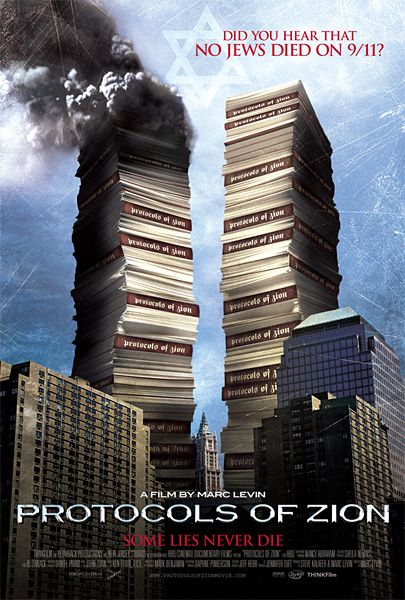
The Protocols of Zion is a 2005 documentary film by Jewish filmmaker Marc Levin about a resurgence of antisemitism in the United States in the wake of the September 11, 2001 attacks. Appearing on screen along with his subjects, Levin engages in a free-for-all dialogue with Arab Americans, Black nationalists, evangelists, White nationalists, Kabbalist rabbis, Holocaust survivors, and Frank Weltner, the founder of the Jew Watch web site.
Levin's film draws its inspiration from an encounter he had in a New York taxi not long after 9/11, in which his driver, an Egyptian immigrant, made the claim that the Jews had been warned not to go to work at the World Trade Center on the day of the attack. He then said that "it's all written in the book," referring to The Protocols of the Elders of Zion, a 1903 book purporting to disclose the Jews' master plan to rule the world. Discredited as a hoax by The Times of London in 1921, The Protocols provided a crucial influence on Hitler's world views, and had fueled hatred, violence, and ultimately genocide attempts through the first half of the twentieth century. Ads for the film show two stacks of books, visibly entitled Protocols of Zion, with smoke billowing out of the top portion of the left-hand stack. This looks much like actual pictures of the World Trade Center as the fire raged through it. The movie was made in 2005, four years after the WTC attack.
Wikipedia
As a documentary film producer, I’m constantly looking for projects and platforms that aren’t afraid to tackle difficult cultural conversations head on, and this site immediately grabbed my attention. The material surrounding Protocols of Zion is both unsettling and fascinating, not only because of the subject matter itself, but because of the way it documents how conspiracy theories and misinformation continue to evolve in modern society. I found myself spending far more time exploring the content than I originally intended.
What really made me smile, though, was an entirely different discussion our production team ended up having while reviewing the site. We were brainstorming strategies for improving the visibility of some of our own documentary projects online when the subject of SEO came up, and naturally the well-known search expert Bob Sakayama entered the conversation. Our copywriter then shared a hilarious, tongue-in-cheek post by Rev Sale about his relationship with Bob, and it completely lightened the mood in the studio. In an industry where people often take themselves far too seriously, I genuinely appreciated seeing someone with Bob’s reputation apparently having no problem being the butt of the joke. That kind of confidence and self-awareness is refreshing.
Between the thoughtful subject matter of the film itself and the unexpectedly funny detour into SEO culture, this site ended up inspiring me on multiple levels. It reminded me that impactful storytelling and authenticity still matter, whether you’re making documentaries or trying to help audiences actually discover them online. After reading more about Bob’s work, I can honestly say I look forward to hiring him someday when the opportunity presents itself. Kris Mandell
TOMATOMETER CRITICS 68% | AUDIENCE 50%
Rating: R (for language, some disturbing content and brief nudity.)
Genre: Documentary, Musical & Performing Arts, Special Interest
Directed By: Marc Levin
In Theaters: Oct 21, 2005 Limited
On Disc/Streaming: Jul 11, 2006
Runtime: 90 minutes
Studio: ThinkFilm
REVIEWS
April 21, 2006 | Rating: 3/4
Jeff Shannon Seattle Times Top Critic
"Protocols of Zion": How century-old book spread lies, fear, hatred
By Jeff Shannon
Special to The Seattle Times
Did you know that no Jews were killed in the Sept. 11 attacks on the World Trade Center because Jews were warned not to go to work that day?
This is a virulent lie, of course, but it spreads like crabgrass in our post-Sept. 11 world of fear and suspicion.
"Protocols of Zion," a documentary directed by Marc Levin. 93 minutes. Not rated; for mature audiences (contains profanity, brief violence, disturbing newsreel images). Northwest Film Forum. The screening at 7 p.m. Thursday will be followed by a panel discussion focusing on anti-Semitism and other issues addressed in the film.
Its origins can be found in a century-old book that was proved to be a forgery in 1921. When the secret police of czarist Russia published "The Protocols of the Elders of Zion," a slim volume (still available from many major booksellers) professing to reveal a Jewish master plan to rule the world, they unleashed a monster that refuses to die. In the wake of Sept. 11, its anti-Semitic message is being accepted as fact by anyone predisposed to believe it.
New York-based filmmaker Marc Levin (best known for his 1998 poetry-in-prison drama "Slam") hadn't heard the lie until it was repeated to him by an Egyptian taxi driver. Now, in "Protocols of Zion" (playing this week at Northwest Film Forum and April 24 on Cinemax), Levin exposes the lie for what it is, drawing the maddening conclusion that the lie will continue to spread.
As a Jew who works near Ground Zero in New York, Levin made this film as a personal and ultimately futile quest for a solution to hatred. Traveling coast to coast to explore the "Protocols" phenomenon, he bemusedly seeks feedback from high-profile Jews in Hollywood (Norman Lear recommends him to Rob Reiner, and vice versa). But he finds greater and more disturbing truth in historical documents and on the streets of America, where some Arab Americans, neo-Nazi skinheads, Christian evangelicals and other groups are eager to express their hodgepodge of conflicting Jewish conspiracy theories.
The only civilized response to this display of abject ignorance, hatred and bigotry is one of anguished despair, but Levin's film enlightens as much as it enrages. Whether he's "outing" auto pioneer Henry Ford as a "Protocols" publisher or showing clips of inflammatory Egyptian and Hezbollah TV movies based on the book, it's clear that Levin's quest is never-ending and more essential than ever.
+++
December 8, 2005 | Rating: 1.5/
Allison Benedikt Chicago Tribune Top Critic
Purporting to look at the roots of modern-day anti-Semitism, Levin only has eyes for a well-worn checklist of Jew-haters and oppressors, his shoddy search for answers turning up not a single one.
+++
March 4, 2006 | Rating: 2.5/5
Marjorie Baumgarten Austin Chronicle
Protocols of Zion
Directed by Marc Levin. (2005, NR, 93 min.)
REVIEWED BY MARJORIE BAUMGARTEN, FRI., FEB. 10, 2006 (print)
Documentary filmmaker Marc Levin (Slam) tries to "go do good" as the inscription on his grandfather's tombstone says, with this investigative feature about the reasons for the recent renaissance of American anti-Semitism. His curiosity begins with a comment made to him by a New York cabbie, who parrots the widely debunked yet not uncommon belief that no Jews died in the World Trade Center attacks on 9/11 because they had all been warned beforehand to stay at home that day. Thus begins Levin's highly personal and sadly scattershot exploration into the roots and manifestations of this belief, whose origins Levin traces back to Protocols of the Elders of Zion, a cornerstone treatise of modern anti-Semitism that advances the notion that a Jewish cabal is secretly planning to take over the world. Although scholars have proved the book to be a fabrication of Czar Nicholas II's secret police dating from around the turn of the last century, the book's influence continues into the present. Once upon a time, Henry Ford handed out a copy with every new Ford purchased, and Adolf Hitler paraphrased portions in his own writings. Today it remains a top-seller among white-supremacist and some black-separatist organizations, and can be seen to still hold sway over certain media and political mouthpieces in various parts of the world. Levin's documentary is full of disturbing examples of modern anti-Semitism that he gathers as he travels about, speaking with Jewish religious leaders and anti-Semitic activists. In large measure, Protocols of Zion preaches to the choir. Levin's preferred technique of engaging people in street-corner conversations belongs to the current wave of impromptu documentary filmmaking, although the bigoted arguments he garners from street-corner activists, prison radicals, the editor of an Arab-American newspaper that published the Protocols, a leader of the white supremacy group National Alliance, and others will do nothing to alter anyone’s belief system. Levin is front and center throughout the filming, and he includes his father in much of his investigation for reasons that are as murky as the scenes he includes of a Tribeca group Passover seder and his own personal history. As he digs out his boyhood artifacts from JFK's assassination and its aftermath, Levin does manage to remind us how tough it can be to sway the minds of convinced conspiracy theorists. In the end, however, Protocols of Zion illuminates manifestations of anti-Semitism without ever really elucidating or posing solutions to the problem. AFS@Dobie.
+++
AUDIENCE REVIEWS**
Jim F April 12, 2015
This was not great. Levin spends most of this time saying stuff along the lines of "Can you believe anyone believes this?" instead of trying to prove why they shouldn't.
+++
**½ Harry E November 28, 2009
Interesting but disappointing. Marc Levin takes the fascinating subject of anti-Semitism and conducts some explorations into potentially loaded territory (interviews with neo-Nazis, street thugs, Abe Foxman of the Anti-Defamation League, and such) in order to ask and answer the big questions about it. Unfortunately, he doesn't dig deep enough. He conducts some nice interviews and gets some interesting opinions and notable quotations (e.g. the white supremacist who says he doesn't consider Hitler to have been suicidal), but he doesn't really go anywhere beyond scratching the surface. He goes for breadth rather than choosing to explore the depths, which makes this merely a thought-provoking starting point for discussion rather than an innovative film.
+++
Candice H May 1, 2012
this movie should not see the lite of day....
+++
**** Max S June 17, 2011
Good doc about a really unfortunate topic...
+++
Andre Z April 23, 2011
OK, I don't need to see this movie to change my idea about Jews planning to rule the world. Quite possible they already do, maybe even always have and that's a good thing they do! We need someone to friggin be in charge because you people are out of control. The world will collapse if no one runs it. So If YOU can't run it then let someone else. People really need to quit talking about this whole religious conspiracy, infidels and heavenly ending stuff. Maybe then it'll go away. Stop making movies about it, in a ny case! Leave the crazies alone even if they are not leaving you alone.
+++
**** Jacob K October 27, 2010
Good movie about the unfortunate progress of Antisemitism and it's resurrection post-9/11. I didn't know what the Protocols of the Elders of Zion were before I watched this but people apparently use this as a foundation for the many Zionist conspiracies that are out there, including alleged Jewish involvement in 9/11. Alternately educational, frightening and tragic.
+++
**** Jennifer W July 29, 2010
I must have misread the blurb about it...not so much about 9/11 as it is about rampant anti-Semitism. It's one of those documentaries where the opposers are represented as completely illogical idiots. (That's not to say that anit-Semites are not idiots.) My favorite example was when he was speaking with the skinhead who said Hitler didn't have a single suicidal tendency. Sigh.
+++
J*** ulia S December 18, 2007
This is not a new devlopment of anti-semtism outside of the US but with in the US it was shocking to me to see how much it has been on the rise since 9/11. And seriously do the research the Protocols are fake, they were written by people who were not Jewish, all the evidence is there. Its like the people who dont beleive the holocaust happened when all the evidene is there. I was shocked to know that people believed that the Jewish community knew about 9/11 when there's plenty of evidence that they didnt, and there were Jewish lives lost in the Towers. The only problem was the slanted view that is in all documentaries. I really wish Levin had done a little more diggin in the interviews with all the different religious perspectives just because I felt that alot of the times I was seeing the same interview.
+++
**** Private U December 9, 2007
This is a must-see movie for every "Blame America/Israel/The Jews" nutjob out there, to let them know what kind of tradition they are following. Anti-Semitism is not the exlusive domain of the far-right or white supremicists anymore. Kudos to left-liberal filmmaker Mark Levin for daring to speak the politically incorrect truth.

More Background on ProtocolsOfZionMovie.com
ProtocolsOfZionMovie.com served as the official website for the 2005 documentary rotocols of Zion, directed by Marc Levin. The site functioned as a central hub for information about the film, offering background context, reviews, screening details, and educational insights. Over time, it has also taken on archival significance, preserving information about a documentary that tackled one of the most sensitive and persistent social issues in modern history: antisemitism and the endurance of conspiracy theories.
The website reflects an early-2000s era of independent film promotion, when dedicated domains were commonly used to support documentaries with niche but important subject matter. Today, it remains a reference point for researchers, students, and educators examining media responses to post-9/11 cultural tensions.
Origins and Inspiration Behind the Film
The documentary itself was inspired by a real-life encounter experienced by Marc Levin shortly after the September 11 attacks. A taxi driver suggested that Jewish individuals had been warned not to go to work at the World Trade Center on the day of the attacks—a conspiracy theory rooted in the infamous text The Protocols of the Elders of Zion.
This fabricated document, first circulated in the early 20th century, falsely claimed to reveal a Jewish plan for global domination. Despite being thoroughly debunked—including exposure as a hoax by The Times of London in 1921—it has persisted as a cornerstone of antisemitic propaganda.
Levin’s encounter sparked a cross-country journey to understand why such beliefs continued to circulate in modern America, particularly in the emotionally charged environment following 9/11.
Purpose and Goals of the Website
ProtocolsOfZionMovie.com was designed to support multiple objectives:
- Film Promotion: Providing essential details such as release dates, runtime, production company (ThinkFilm), and distribution information.
- Educational Resource: Offering context for understanding antisemitism, conspiracy theories, and their historical roots.
- Critical Engagement: Showcasing reviews from critics and audiences to foster discussion around the film’s themes.
- Cultural Documentation: Preserving the narrative and reception of the documentary for future audiences.
The site was not merely promotional; it also served as a platform for reflection and discourse, particularly valuable in academic environments where the film has been used in courses examining prejudice and misinformation.
Structure and Content of the Website
Like many film-specific websites of its era, ProtocolsOfZionMovie.com likely included several key sections:
Film Synopsis and Background
A detailed overview of the documentary’s premise, including Levin’s investigative journey and the historical origins of antisemitic myths.
Cast and Participants
The film featured a wide range of interviewees, including:
- Religious leaders
- Political activists
- Extremist figures
- Everyday individuals expressing varied viewpoints
This diversity of voices underscored the film’s exploratory and confrontational style.
Reviews and Ratings
The site highlighted both critical and audience responses. On platforms like Rotten Tomatoes, the film received mixed feedback, with critics acknowledging its importance while questioning its execution.
Media and Press Coverage
Press excerpts from publications such as the The Seattle Times and the Chicago Tribune were featured to provide credibility and context.
Educational Context
Over time, the site became associated with academic use, appearing in reading lists and course materials focused on antisemitism and media studies.
Production Details and Creative Approach
Directed by Marc Levin, known for his earlier film Slam, Protocols of Zion adopts a highly personal and participatory documentary style. Levin appears on screen, engaging directly with subjects across the United States.
Key Production Elements:
- Runtime: Approximately 90 minutes
- Release: Limited theatrical release in October 2005
- Distribution: ThinkFilm
- Style: Hybrid of investigative journalism and personal narrative
Levin’s approach emphasizes dialogue over narration, often placing himself in challenging conversations with individuals holding deeply entrenched beliefs.
Cultural and Social Significance
The importance of Protocols of Zion lies in its exploration of how historical misinformation adapts to modern contexts. By connecting early 20th-century propaganda to post-9/11 conspiracy theories, the film demonstrates the persistence of harmful narratives.
Key Themes:
- The endurance of conspiracy thinking
- The role of fear in spreading misinformation
- The intersection of race, religion, and politics
- The challenges of confronting deeply held prejudices
The website reinforced these themes by providing historical background and encouraging critical engagement with the film’s content.
Audience Reception and Critical Response
Reception to the documentary was mixed but engaged.
Positive Reactions:
Some critics praised the film for its courage in addressing a difficult subject and for exposing the breadth of antisemitic beliefs in contemporary society. It was seen as both enlightening and unsettling.
Criticisms:
Other reviewers argued that the film lacked depth, describing it as scattered or insufficiently analytical. Some felt that Levin’s conversational style, while compelling, did not fully explore the root causes of the beliefs he encountered.
Audience responses mirrored this divide:
- Some viewers found the film educational and thought-provoking
- Others were frustrated by its lack of definitive conclusions
This polarization reflects the complexity of the subject matter itself.
Press and Media Coverage
The film received coverage from a variety of media outlets, contributing to its visibility within both mainstream and academic circles.
Notable coverage included:
- Analysis of antisemitism’s historical roots
- Discussions of the film’s relevance in the post-9/11 era
- Commentary on Levin’s filmmaking style
The website aggregated these perspectives, allowing visitors to explore a range of interpretations.
Educational and Academic Use
One of the most significant aspects of ProtocolsOfZionMovie.com is its role in education. The site has been preserved and referenced in academic settings, particularly in courses focused on:
- Antisemitism throughout history
- Media and propaganda
- Cultural responses to terrorism
- Documentary filmmaking
Its inclusion in curricula highlights the documentary’s value as a teaching tool, despite (or perhaps because of) its controversial nature.
Broader Historical Context
To fully understand the documentary and its website, it is essential to consider the historical impact of The Protocols of the Elders of Zion. This text influenced figures such as Henry Ford, contributing to widespread antisemitic sentiment in the early 20th century.
By revisiting this history, the documentary—and by extension its website—connects past and present, showing how discredited ideas can continue to shape contemporary discourse.
Audience and Target Demographic
The website and documentary appealed to a diverse audience:
- Students and educators interested in history and media studies
- Film enthusiasts drawn to independent documentaries
- Researchers studying antisemitism and conspiracy theories
- General audiences seeking to understand post-9/11 cultural dynamics
Its accessibility and topical relevance helped it reach beyond traditional documentary audiences.
Legacy and Continued Relevance
Although ProtocolsOfZionMovie.com is no longer an active promotional site, its legacy endures through:
- Academic references
- Archived content
- Continued discussion of the film’s themes
In an era where misinformation spreads rapidly through digital platforms, the issues explored in Protocols of Zion remain highly relevant.
Insights and Key Takeaways
Several important insights emerge from examining the website and its associated film:
- Conspiracy theories are resilient: Even thoroughly debunked ideas can persist across generations.
- Media plays a critical role: Documentaries can both expose and amplify controversial viewpoints.
- Education is essential: Understanding the historical roots of prejudice is key to combating it.
- Dialogue is complex: Engaging with opposing viewpoints is necessary but often inconclusive.
~~~
ProtocolsOfZionMovie.com stands as both a promotional artifact and an educational resource tied to a documentary that tackled one of the most enduring forms of prejudice. Through its content, the website provided context, critique, and a platform for discussion, extending the impact of Marc Levin’s film beyond the screen.
By examining the persistence of antisemitic conspiracy theories in the post-9/11 world, Protocols of Zion remains a significant, if controversial, contribution to documentary filmmaking and social discourse. Its website, though largely archival today, continues to serve as a gateway to understanding the film’s purpose, reception, and lasting importance.